


 English

 January 26, 2026
Setting up a Limited Liability Company in Dubai can feel like a high-stakes decision, especially for British and American entrepreneurs aiming for clarity and success from day one. The company structure you choose and how accurately you define your business activity will shape everything from ownership flexibility to regulatory compliance and market access. This guide explains each critical stage so you can build your Dubai business on a strong legal foundation and avoid costly missteps.
| Key Insight | Explanation |
|---|---|
| 1. Define business activity precisely | Specificity in your business activity determines license type and regulatory compliance. Ensuring clarity prevents future complications. |
| 2. Choose the right legal structure | Selecting an LLC provides liability protection and allows 100% foreign ownership. This is crucial for safeguarding personal assets. |
| 3. Understand jurisdiction implications | The decision between mainland and free zone affects market access and operational flexibility. Choose based on your business needs. |
| 4. Prepare all required documents | Accurate documentation is essential for smooth application submission. Missing or incorrect documents can severely delay your registration process. |
| 5. Maintain ongoing compliance | Regularly renew your business license and keep accurate financial records to avoid penalties. Staying organized ensures smooth operations. |
You’re about to make one of the most consequential decisions in your Dubai business setup, and getting it right from the start saves you headaches later. Defining your business activity and choosing the right legal structure determines everything from your licensing requirements to your tax obligations and ownership flexibility. This step locks in your company’s foundation, so you need to be intentional about what you decide here.
The good news is that Dubai offers several legal structures to choose from, with the Limited Liability Company (LLC) being the most popular choice for foreign entrepreneurs. LLCs provide limited liability protection, which means your personal assets remain separate from your business obligations. What makes this structure particularly attractive is that many business activities now allow 100% foreign ownership, a significant advantage that wasn’t available to international business owners just a few years ago. An LLC also offers flexibility with up to 50 shareholders and provides your company with a separate legal identity, which is crucial for banking, contracts, and credibility in the market.
Here is a quick overview of Dubai’s main business legal structures and their features:
| Structure Type | Ownership Flexibility | Liability Protection | Minimum Shareholders |
|---|---|---|---|
| LLC | Up to 100% foreign owned | Personal assets protected | 2 (up to 50) |
| Sole Establishment | 100% owned by one person | Full personal liability | 1 |
| Civil Company | Only for professionals | Shared liability | 2 or more partners |
| Branch Office | Extension of parent company | No separate liability | Not applicable |
Now, here’s where most entrepreneurs get tripped up. You need to be very specific about your business activity because it directly governs your license type, compliance requirements, and the registration process itself. Don’t just say “consulting” when you mean “IT consulting for fintech startups.” The more precise you are, the better. Your business activity falls into one of three main licensing categories: commercial (trading goods and services), industrial (manufacturing and production), or professional (specialized services like accounting or engineering). Each category has different regulations and fee structures. Under Federal Decree Law No. 32 of 2021, which governs commercial companies in the UAE, your chosen activity must be clearly documented and must comply with all relevant regulations. If your business spans multiple activities, you might need multiple licenses, so clarity upfront prevents costly amendments later.
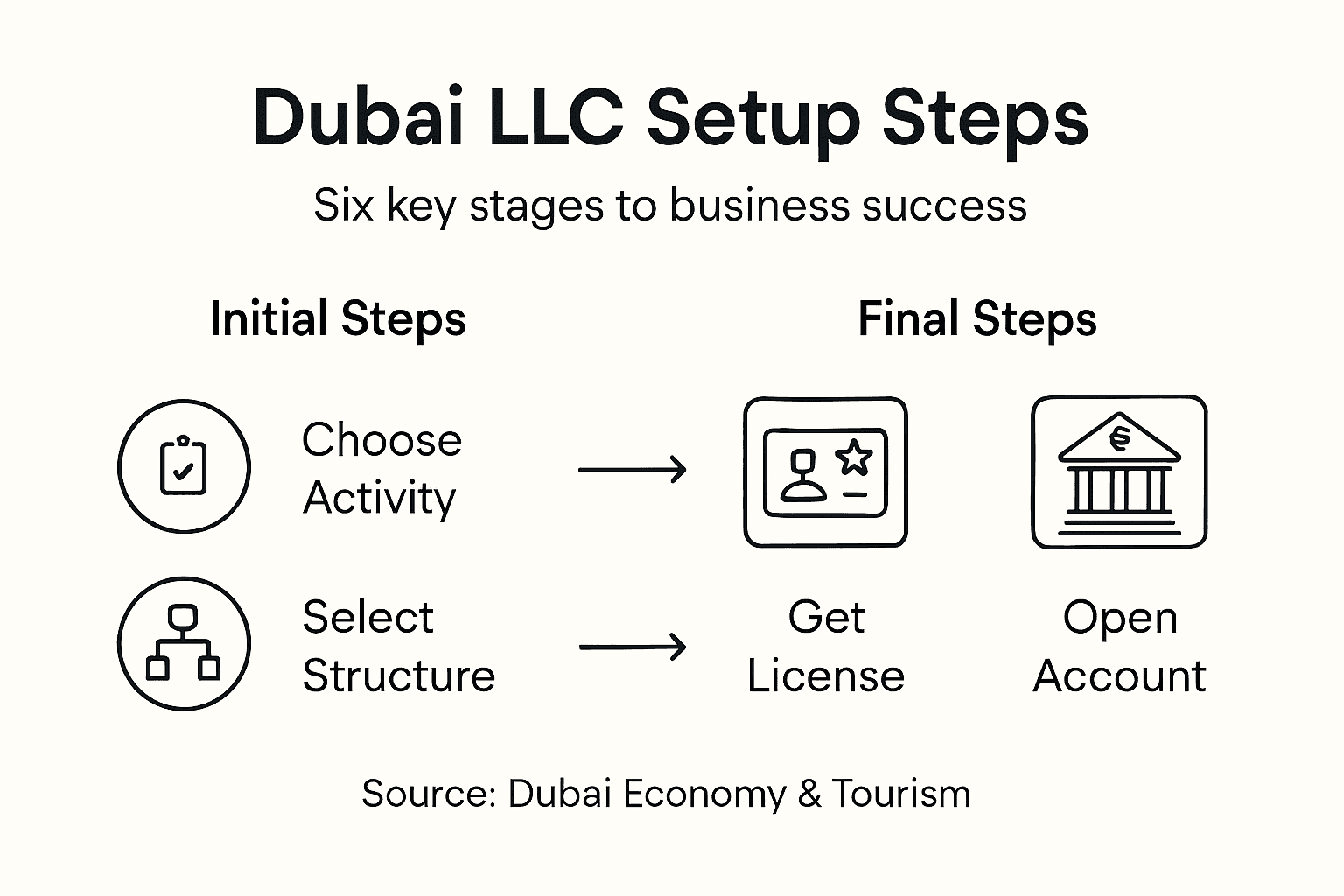
Pro tip: Review the Department of Economy and Tourism’s complete activity list before finalizing your choice, and consider selecting activities that position your company for future expansion without requiring a license amendment.
You’re at a critical juncture where location and branding intersect. Choosing the right jurisdiction and securing your company name are two decisions that directly impact your operational costs, regulatory requirements, and market identity. These decisions happen simultaneously, so it’s worth thinking through both carefully before you submit anything.
First, let’s talk jurisdiction. You have two main paths in Dubai: mainland or free zone. The mainland gives you access to the broader UAE market and allows you to conduct business anywhere in the emirate, which appeals to most foreign entrepreneurs establishing service-based or trading businesses. Free zones offer tax incentives and simplified setup processes but restrict your business operations to that specific zone. When selecting your jurisdiction, you’re choosing which government authority oversees your company. Each emirate has its own Department of Economic Development or equivalent body that handles registration. Dubai’s Department of Economy and Tourism manages mainland registrations, while each free zone (like the Dubai Silicon Oasis or International Financial Centre) has its own administrative structure. The jurisdiction you pick affects your license fees, renewal costs, and which regulations apply to your operations. Most foreign entrepreneurs new to Dubai choose mainland because it provides more flexibility and accessibility to the wider market.
This comparison highlights key differences between mainland and free zone jurisdictions in Dubai:
| Factor | Mainland | Free Zone |
|---|---|---|
| Market Access | Entire UAE | Limited to specific zone |
| Ownership | Up to 100% foreign permitted | Usually 100% foreign allowed |
| License Renewal | Department of Economy and Tourism | Zone authority |
| Operational Flexibility | Broad business activities | Restricted to zone-related activities |
Now for the name reservation, which is where many people stumble. Your company name isn’t just a branding exercise; it must comply with strict UAE naming conventions. Your trade name must be unique and compliant with naming laws, meaning it can’t be similar to any other registered entity in your jurisdiction. The name must include a legal suffix like LLC, and you can’t use offensive, misleading, or inappropriate terms. The name should also clearly reflect your business activity or at least not contradict it. You’ll submit your name choice to the Department of Economic Development for the mainland or to your chosen free zone authority. They check it against the existing registry and either approve it or reject it with reasons why. This is why having backup name options ready is smart. Once approved, your trade name is reserved for a specific period while you complete the rest of the registration process.
Pro tip: Choose a jurisdiction and name that support future growth; if you’re launching with one activity but planning to expand, pick a jurisdiction with the regulatory flexibility for your next phase, and select a company name broad enough to encompass related services.
You’re now entering the administrative phase where paperwork meets government systems. Gathering the right documents and submitting them correctly is what transforms your business idea into an officially registered company. This step requires attention to detail because missing or incorrect documents send your application back to the starting line.
Let’s walk through what you actually need to submit. Company establishment requires several key documents including your trade name reservation certificate, which proves you’ve secured your company name. You’ll need the approval of your business activity document, which confirms your chosen activities comply with regulations. The Memorandum of Association, or MoA, is a critical document that outlines your company’s structure, ownership shares, and operational rules. This is where you formally document how many shares each shareholder owns and what percentage of the company they control. Passport copies of all shareholders are required to verify identity. If you’re bringing in investors or partners from outside the UAE, you may need no-objection certificates from their home countries, though this depends on your specific circumstances. You’ll also need proof of your registered office address, which can be a physical location or a virtual office arrangement. Finally, you’ll pay the prescribed registration fees, which vary depending on your jurisdiction and business activity. Don’t try to guess at fees, as undershooting delays approval and overpaying is just wasteful.
When it comes to submission, you have flexibility in how you file. You can submit everything online through government digital portals, which is faster and creates an immediate digital record of your application. Alternatively, you can submit physical documents at the Department of Economic Development office in person, though this typically takes longer. Most foreign entrepreneurs prefer online submission because it eliminates the back-and-forth of visiting offices and provides real-time tracking of your application status. After submission, the government reviews your documents, checks for completeness and compliance, and either approves your application or requests additional information. Approval timelines typically range from a few days to two weeks depending on the jurisdiction and how clearly you’ve prepared your documents.
Pro tip: Prepare digital copies of all documents and keep the originals organized in a folder; submit online first and save your confirmation receipt, which serves as proof of application if any questions arise during processing.
You’re approaching the finish line where your company transitions from approved on paper to legally authorized to operate. Obtaining your business license is the final gate between registration and actual operations. This step varies depending on your business type, but the core principle remains the same: you need official permission from the appropriate government authority before you can legally conduct business.
The licensing process depends on which jurisdiction you chose earlier. If you established on the mainland, business licensing in Dubai is handled by the Department of Economy and Tourism, which issues licenses across multiple sectors including commercial, professional, industrial, and tourism. If you chose a free zone, that specific free zone authority handles your licensing. The type of license you receive matches your business activity. A commercial license covers trading activities like importing and selling goods. A professional license applies to service providers like consultants, accountants, or engineers. An industrial license is for manufacturing or production. Tourism licenses cover hospitality and related services. Each category has different requirements and fee structures. You’ll submit your documented approval of business activity along with any additional documents specific to your sector. Some activities require background documentation or proof of qualifications. For example, if you’re establishing a healthcare-related business, you may need medical credentials or facility certifications.
Here’s where regulatory approvals come into play. Certain activities require additional government approvals or inspections before your license can be finalized. A food business needs health and safety approvals. A financial services company needs Central Bank clearance. A real estate firm needs specific regulatory sign-off. Don’t skip this step thinking your commercial approval covers everything, because it doesn’t. These sector-specific approvals can take time, so budget for them in your timeline. Once all approvals are in place and fees are paid, your license is issued. This document legally permits you to operate your business within your chosen jurisdiction and confirms compliance with all applicable standards. Keep your original license in a safe place and maintain compliance throughout your operations because your license can be suspended or revoked if you violate regulations.
Pro tip: Contact the Department of Economy and Tourism or your free zone authority before submitting to ask specifically which sector-specific approvals your activity requires; this prevents surprises and keeps your timeline on track.
You’re in the final stretch of making your Dubai business operational. Opening a corporate bank account and securing office space are two parallel processes that happen around the same time. Both are non-negotiable for establishing credibility, handling transactions legally, and having a physical or virtual presence from which to operate.
Let’s start with the bank account because it’s straightforward if you have your documents in order. Once your business license is issued, you can approach UAE banks to open a corporate account. Banks require your original business license, Memorandum of Association, passport copies of shareholders and authorized signatories, proof of registered office address, and a company bank introduction letter from your accountant. Different banks have slightly different requirements, so call ahead to confirm their specific checklist. American and British entrepreneurs often find that banks ask for additional documentation like home country address verification or proof of funds origin, especially if you’re transferring money internationally. The account opening process typically takes 5 to 10 business days. Once your account is active, you can start conducting business transactions, paying salaries, and managing company finances through a legitimate UAE banking channel.

Office space requires more strategic thinking. Renting office space in Dubai involves securing a lease registered with the Ejari system through the Dubai Land Department, which is the official property registration system. Your lease must be legally documented and registered to be valid. The property must comply with commercial zoning regulations, meaning you can’t rent a residential apartment and call it your business office. If you’re operating a free zone company but need a mainland presence, you’ll need a No Objection Certificate from your free zone authority, which allows the property to serve as your registered address. Office size and location requirements vary depending on your business activity and license type. A consultant might only need a small office, while a trading company might require warehouse space. Many entrepreneurs starting out use virtual office solutions or coworking spaces, which provide a legitimate registered address while keeping costs low. Whatever you choose, ensure your registered address matches your business license and banking records.
Pro tip: Start your bank account and office space search simultaneously; have your bank requirements and office lease drafted before submitting them, as delays in either one hold up the other, and coordinating the timing prevents frustrating gaps.
You’ve crossed the finish line, but the real work of running a compliant business begins now. Verifying that your setup is complete and understanding your ongoing compliance obligations prevents costly penalties and keeps your company in good standing. This final step is about confirming you have everything in place and knowing what to maintain going forward.
Start by creating a verification checklist of everything you’ve accomplished. Confirm that your business license is issued and active, your company is registered in the commercial register with an official number, your bank account is operational and linked to your business, and your office address is properly documented. Pull up your Department of Economic Development file and verify that all documents match what you submitted. Cross-check that your company name, business activities, ownership structure, and authorized signatories are exactly as intended. If anything looks incorrect, contact the Department immediately to request amendments before issues compound. You should also verify that your company appears in official UAE business registries when you search by name or registration number. This public registration is your proof of legitimate status to customers, suppliers, and partners. Many foreign entrepreneurs overlook this verification step and later discover discrepancies that create headaches during contract negotiations or banking transactions.
Now let’s talk ongoing compliance because your setup is just the beginning. Your business license must be renewed annually, typically before the expiration date printed on your certificate. You’ll need to renew your trade license each year with the Department of Economic Development or your free zone authority. If your business activities change or expand, you must apply for amendments to your license rather than operating outside your approved activities. You must maintain accurate financial records and file annual financial statements with the government within specific deadlines. If your company has employees, you’re responsible for timely salary payments, labor contract compliance, and contributions to the UAE social security system. Your office lease must remain current and registered, and your registered address cannot change without notifying the Department. Tax compliance is critical, even if you operate in a tax-free zone, because certain taxes like corporate income tax may apply depending on your structure. Failure to comply with any of these requirements can result in penalties, license suspension, or even criminal liability. The good news is that most of these are straightforward if you stay organized and calendar your renewal dates.
Pro tip: Create a compliance calendar marking your license renewal date, annual financial statement deadline, and lease renewal date at least 90 days in advance, and assign responsibility to one team member to monitor these dates so nothing slips through.
Starting your Dubai LLC involves critical steps like selecting the right business activity and legal structure, choosing the ideal jurisdiction, completing precise documentation, obtaining licenses, and securing banking and office arrangements. Feeling overwhelmed by the complexity or worried about compliance pitfalls is natural when every detail counts toward your success.
At SetupDubaiBusiness.com, we understand the challenges you face in navigating Dubai’s business landscape. Our professional services are designed to guide you through each phase from name reservation to license issuance with efficiency and clarity. Whether it is ensuring you meet all regulatory approvals, opening your corporate bank account smoothly, or finding the perfect office solution, we provide tailored assistance to protect your investment and save you valuable time.
Take the stress out of your Dubai business setup today. Explore our comprehensive services at SetupDubaiBusiness.com and start your LLC journey with confidence. Don’t wait until delays or missed steps slow you down. Visit us now and turn your Dubai business vision into reality.
To set up a Limited Liability Company (LLC) in Dubai, first define your business activity and legal structure. Next, select your jurisdiction, reserve your company name, complete the necessary documentation, obtain your business license, open a corporate bank account, and secure office space. Follow these steps in order for a smooth setup.
To maintain compliance, verify that your business license is active and all registration details are correct. Create a compliance calendar to track key dates for license renewal, financial reporting, and lease renewals, ensuring you handle these tasks at least 90 days in advance.
You will need several key documents, including a trade name reservation certificate, approval of your business activity, a Memorandum of Association, and passport copies of shareholders. Prepare these documents thoroughly to avoid delays during submission.
The entire process of setting up your LLC in Dubai can take anywhere from a few days to several weeks, depending on how efficiently you prepare your documentation and navigate the approval stages. Aim to complete key steps, like licensing and bank account setup, within 30 to 60 days to start operations promptly.
Costs for setting up an LLC in Dubai vary based on your chosen jurisdiction, license type, and office requirements. Budget for registration fees, office leasing expenses, and bank account maintenance, and consult local resources to get an accurate estimate of your overall expenses.
No, if you register your LLC in a specific jurisdiction, you are typically limited to operating within that area. If you plan to expand your operations, consider selecting a jurisdiction that allows broader access from the outset.

Get a Quote
WhatsApp Italiano
 简体中文
简体中文 Русский
 日本語
日本語 عربى
عربى