


 English

 January 23, 2026
Setting up a mainland LLC in Dubai can feel overwhelming for British and American entrepreneurs who expect the simple paper filing they use at home. Unlike the lengthy waits common elsewhere, the UAE’s Basher platform delivers commercial license approval within minutes, but understanding the right license type and business structure is crucial for success. This guide untangles each step, helping you avoid registration pitfalls and meet every compliance requirement with confidence.
| Point | Details |
|---|---|
| UAE Company Formation | Establishing a company in the UAE involves a streamlined process that typically results in quick approvals through digital platforms. Choosing the right license type and jurisdiction is crucial for operational success. |
| Company Structure Options | Foreign entrepreneurs mainly consider Limited Liability Companies (LLCs), which offer protection and flexibility, with options for both mainland and free zone structures depending on business focus. |
| Legal and Financial Compliance | Understanding the legal framework is essential to protect personal assets and ensure compliance with UAE laws, including governance and financial reporting requirements. |
| Common Pitfalls | Entrepreneurs should avoid misclassifying business activities and underestimating costs, while seeking professional guidance early in the process to prevent costly mistakes. |
UAE company formation is the process of establishing a legal business entity in the United Arab Emirates. For entrepreneurs from the UK and US, it’s essentially the Gulf equivalent of registering a corporation or LLC back home, but with some distinct advantages and procedural differences. The process involves securing government approval, obtaining a commercial license, and registering your business structure through the appropriate government authority. Unlike many Western jurisdictions where you might file papers and wait weeks, the UAE system has been designed for speed and efficiency, recognizing that foreign investors represent significant economic value to the nation.
The core of UAE company formation revolves around applying for a commercial license through your chosen emirate’s Department of Economic Development. You have the flexibility to apply in person or digitally, depending on which works best for your schedule. The system has been revolutionized through the Basher platform, which allows commercial license approval within minutes, eliminating the bureaucratic delays you might expect. As part of this process, you’ll need to select from six main license types based on your business activities: occupational, tourism, industrial, commercial, agricultural, or professional. Your chosen trade name must be unique within the emirate, and you’re required to include a legal structure abbreviation like LLC in your business name. This combination identifies both your business identity and your legal structure in one registered name.
When establishing a mainland company in Dubai or another emirate, you’re making a strategic choice about how your business will operate and where it will be physically located. Mainland entities operate throughout the emirate and beyond, unlike free zone companies that function only within their designated zones. This makes mainland formation ideal if you plan to serve local customers, operate a physical office, hire UAE-based employees, or conduct business across multiple emirates. The process of mainland company formation in Dubai follows specific steps that, while straightforward on the surface, involve coordinating with multiple government departments and ensuring every detail aligns with local regulations. Understanding these distinctions upfront prevents costly mistakes that could delay your launch or require expensive corrections later.
The beauty of the UAE system, particularly from a foreign entrepreneur’s perspective, is that government authorities have unified their processes. Rather than navigating fragmented agencies with conflicting requirements, you work through streamlined digital platforms designed for efficiency. This represents a major shift from the paper-based, slow-moving bureaucracies many American and British business owners are accustomed to. However, UAE company formation does involve specific legal requirements, documentation standards, and compliance expectations that differ markedly from UK or US norms. The regulatory framework prioritizes legitimacy and transparency, meaning your application will be thoroughly reviewed and your business structure must align with UAE commercial law. This isn’t a loophole or a shortcut approach. It’s a legitimate, government-sponsored process designed to welcome foreign investment while maintaining national business standards.
Pro tip: Start your company formation process by clearly identifying which license type matches your core business activities, as this single decision determines your regulatory pathway and approval timeline. Misclassifying your business activity can delay approval or force you to restart the process entirely, so invest time upfront in getting this detail right.
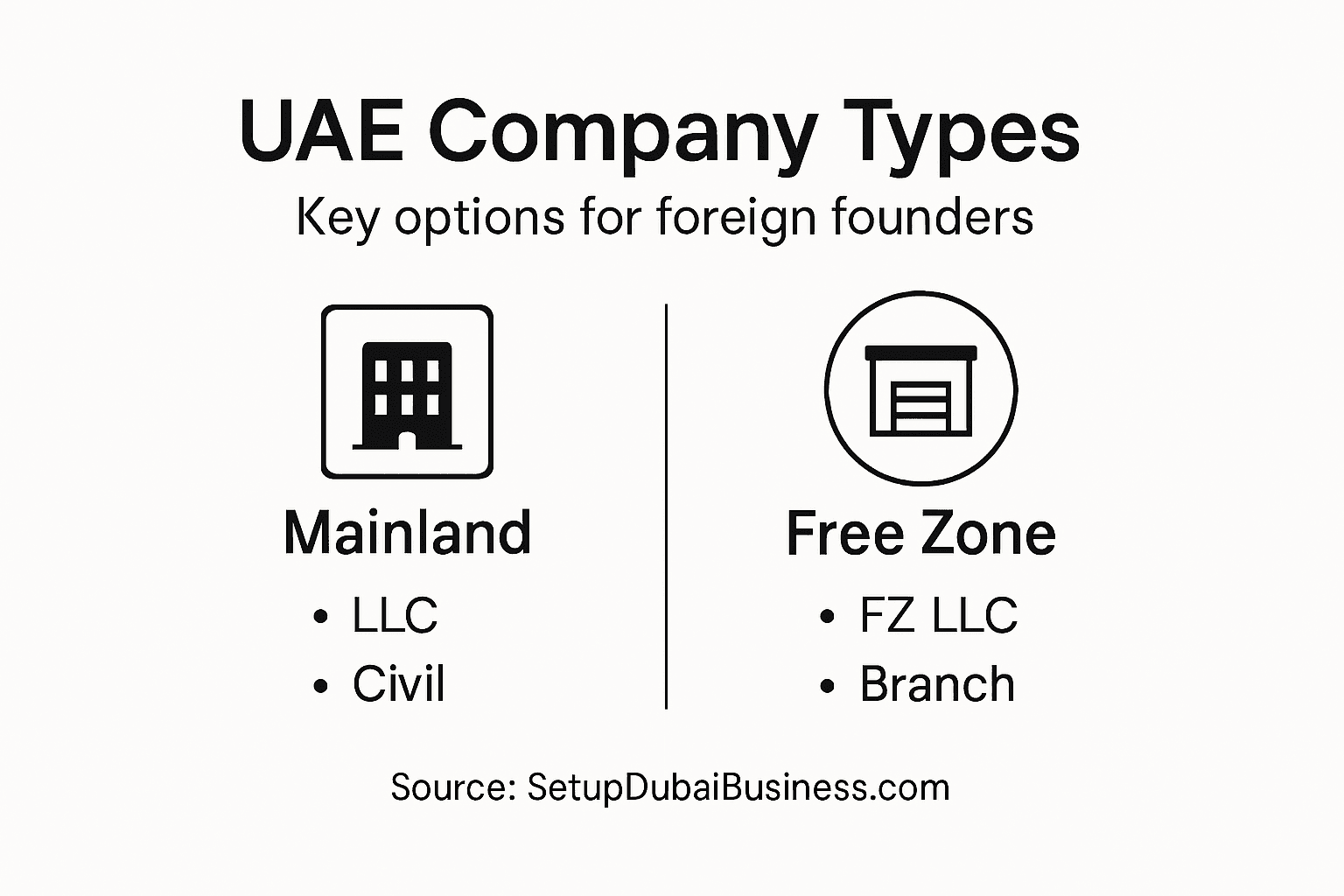
The UAE doesn’t offer a one-size-fits-all company structure. Instead, you get to choose from multiple business entity types, each with distinct advantages depending on your specific circumstances. The decision you make here shapes your operational flexibility, tax treatment, ownership rules, and regulatory oversight. As a UK or US entrepreneur, you’re probably familiar with LLCs, S-corps, or partnerships back home. The UAE system works differently, so understanding your options upfront prevents selecting a structure that doesn’t align with your business goals. The main company types available include LLC, joint stock companies, partnerships, and branches of foreign companies, each governed by local economic departments with specific regulations and ownership requirements.
The most popular choice for foreign entrepreneurs is the Limited Liability Company (LLC). An LLC in the UAE provides personal liability protection for owners while offering straightforward management and operational flexibility. When you register an LLC, your personal assets remain separate from business liabilities, meaning creditors can’t pursue your personal bank account or property if the business faces legal issues. For mainland companies, the typical ownership structure requires UAE nationals to hold a minimum stake, usually 51 percent, with foreign investors holding up to 49 percent. Free zone LLCs operate differently, allowing 100 percent foreign ownership without requiring local partners. Beyond LLCs, you can establish general partnerships (where all partners share liability), limited partnerships (mixing active and passive partners with varying liability levels), or joint stock companies (larger entities with shares traded publicly or privately). For established foreign businesses, establishing a branch of your existing company allows you to operate under your parent company’s name while maintaining separate UAE registration and compliance obligations.

Your choice between mainland and free zone placement creates another critical decision point. Mainland companies operate throughout the emirate and across the entire UAE, making them ideal if you’re targeting local customers, operating retail locations, hiring UAE-based staff, or conducting business with other UAE companies. A mainland LLC requires local partnership (typically 51 percent UAE national ownership for traditional mainland setups), though some sectors offer 100 percent foreign ownership under specific government initiatives. Free zone companies operate only within their designated zone, but offer significant advantages including 100 percent foreign ownership, simplified customs procedures, corporate tax exemptions, and streamlined regulatory requirements. Free zones work exceptionally well for trading, logistics, import/export, consulting, or tech services where your primary client base extends internationally rather than locally. The choice fundamentally comes down to your business model. If you’re importing goods and selling internationally, a free zone location makes sense. If you’re targeting UAE customers or need physical presence across the emirate, mainland registration serves you better.
You’ll also encounter offshore companies and civil companies as options, though these serve more specialized purposes. Offshore companies typically function for holding assets, international trading, or wealth management rather than direct UAE business operations. Civil companies serve specific professional sectors like medical practices, law firms, or engineering consultancies. Most foreign entrepreneurs establishing operational businesses choose between mainland LLCs and free zone LLCs. The decision hinges on one simple question: Who are your primary customers and where do they operate? Answer that accurately, and your company type selection becomes obvious. Start by clarifying your revenue streams. Will you primarily serve UAE customers, international clients, or both? Your answer determines whether mainland or free zone registration makes financial and operational sense.
Here’s a comparison of key UAE company types to help clarify their distinct features:
| Company Type | Ownership Rules | Main Advantage | Typical Use Case |
|---|---|---|---|
| Mainland LLC | Up to 100% foreign (some sectors); often 51% UAE national | Access to UAE market | Retail, local services |
| Free Zone LLC | 100% foreign allowed | Tax benefits, easy setup | Import/export, tech services |
| Offshore Company | 100% foreign | No local business, asset holding | International trading, holding assets |
| Civil Company | 100% foreign in some professions | Suitable for professionals | Legal, medical, engineering firms |
| Joint Stock Company | Public or private shareholders | Attracts investment through shares | Large-scale or public ventures |
| Branch of Foreign Company | Owned by parent company | Enter UAE market without new entity | Global firms extending presence |
Pro tip: Before committing to a company structure, research whether your specific business activity qualifies for 100 percent foreign ownership initiatives or free zone benefits in your chosen emirate, as this single factor can eliminate years of mandatory partnership arrangements and dramatically increase your operational control.
When you register an LLC in Dubai, you’re not operating in a legal vacuum. Your company exists within a specific regulatory structure called the UAE Limited Liability Companies Law, which defines everything from how you organize ownership to how you handle disputes with partners. This legal framework exists for a reason. It protects your personal assets, establishes clear operational rules, and creates predictability for foreign investors entering the UAE market. Understanding this framework upfront prevents costly surprises down the road. The law delineates shareholder rights, governance structures, compliance obligations, and dispute resolution mechanisms, providing a legal scaffold that governs how your business operates day to day.
At the foundation of LLC law sits a simple but critical rule: your personal liability is limited to your capital contribution. If you invest $50,000 in your LLC and the company faces a lawsuit or debt of $500,000, your personal assets remain untouched. Creditors can only pursue company assets, not your personal bank account or property. This is the core benefit of LLC structure and why it appeals to foreign entrepreneurs. The law supports this protection by establishing that LLCs can have between 2 to 50 shareholders, with each shareholder’s liability capped at their ownership stake. This structure mirrors LLC protection in the United States, though the specific regulatory mechanisms differ. The law also specifies that your company must maintain a board or designated manager responsible for governance and operational oversight. This requirement ensures accountability and prevents situations where nobody is legally responsible for business decisions.
Governance and Financial Compliance Requirements
Your LLC doesn’t operate autonomously once registered. The legal framework mandates specific governance structures and financial reporting obligations. Every LLC must appoint either a board of directors or a single manager who holds legal responsibility for company decisions and regulatory compliance. This person or group handles contracts, employment decisions, financial matters, and represents the company in legal proceedings. Beyond governance, the law requires comprehensive financial reporting and audit requirements for companies meeting certain thresholds. These requirements enhance transparency and investor confidence, meaning creditors, potential partners, and government authorities can verify that your company operates legitimately. For many foreign entrepreneurs, this transparency requirement feels familiar compared to US or UK standards, though the specific reporting formats and timelines differ. You’ll need to maintain detailed financial records, submit annual reports to government authorities, and undergo audits depending on your company size and structure.
Recent legal reforms have expanded opportunities for foreign ownership. The UAE government has progressively increased foreign ownership permissions across multiple business sectors, moving away from strict 51/49 partnership requirements. Many sectors now allow 100 percent foreign ownership without mandatory local partners, dramatically changing the LLC formation calculus for international entrepreneurs. This evolution reflects the UAE’s strategic priority to attract foreign investment and international talent. However, some sectors still maintain partnership requirements, and these vary by emirate and business activity. Immigration law, retail trade, construction, and certain professional services often retain local ownership requirements, though exceptions exist. The legal framework continues evolving, so your specific business activity and emirate determine which ownership rules apply to your situation.
Dispute Resolution and Legal Remedies
Should conflicts arise with your business partners, employees, or clients, the LLC legal framework provides clear dispute resolution mechanisms. Rather than navigating uncertain court systems, LLC law establishes arbitration procedures, mediation requirements, and defined legal remedies. This structured approach protects all parties and prevents disputes from spiraling into protracted, expensive litigation. The legal framework also addresses partner rights and obligations, defining how profits are distributed, how major decisions are made, and what happens if a partner wants to exit the business. These provisions prevent misunderstandings that commonly derail partnerships.
Pro tip: Before finalizing your LLC structure, have a local legal advisor review your specific business activity against current UAE foreign ownership rules, as these regulations change periodically and directly impact whether you can maintain full control or must accept a local partner with specific ownership percentage.
Forming a mainland LLC in Dubai follows a structured pathway with distinct phases. The process isn’t mysterious or unnecessarily complicated, but it does require attention to detail and sequential completion of steps. Unlike some Western jurisdictions where you can file documents and receive approval weeks later, the UAE system moves significantly faster when you have your documentation in order. The UAE Government platform outlines clear procedures that, when followed correctly, typically result in approval within days. Here’s what you actually need to do, broken down into actionable steps that move you from concept to operating business.
Start by clearly defining what your business will actually do. This isn’t vague handwaving about your “consulting services.” You need to identify specific business activities that align with government license categories. Will you be trading goods? Providing professional services? Running a retail operation? Operating a manufacturing facility? The step-by-step mainland business establishment process requires you to specify your primary and secondary activities, as these determine which business license type applies and what regulatory oversight you’ll face.
Once you’ve identified your activities, select your legal structure. For most foreign entrepreneurs, this means choosing an LLC. You’ll specify the ownership structure at this stage, determining whether you’ll operate with a local partner (typical 51/49 split for mainland companies) or seek 100 percent foreign ownership if your business activity qualifies. This decision shapes everything downstream, including your capital requirements, partner obligations, and management structure. Get this decision right before moving forward.
Your chosen business name must be unique within the emirate. You can’t call your company “Dubai Trading” or anything else already registered. Submit your proposed trade name for verification through the Department of Economic Development’s digital platform. The system checks availability instantly. Your name must include a legal structure identifier like “LLC” or the Arabic equivalent. Once approved, your name is reserved, preventing competitors from snatching it while you complete remaining steps.
With your name reserved and business activity confirmed, you’ll receive preliminary approval from the Department of Economic Development. This isn’t your final license yet. It’s clearance to proceed with the next phase, confirming that your business activity is permitted in the emirate and your proposed structure aligns with regulations.
The Memorandum of Association (MOA) is your company’s constitutional document. It outlines ownership percentages, profit distribution, management structure, decision-making authority, and shareholder obligations. If you have a local partner (the 51 percent owner in traditional mainland setups), the MOA defines their role and rights. This document prevents misunderstandings that commonly derail business partnerships. You can work with a legal consultant or use template language provided by government agencies. The MOA must comply with UAE commercial law requirements and clearly address liability, profit sharing, and governance mechanisms.
Simultaneously, you need to secure physical office space. Mainland companies must have a registered address within the emirate. You can lease a dedicated office, use a business center, or register a virtual office address, depending on your business type and emirate regulations. Your landlord will provide a tenancy contract, which you’ll submit as part of your documentation package. This isn’t optional. Government authorities verify that your registered address is genuine before issuing your license.
Compile your complete documentation package: your MOA, office tenancy contract, identification documents for all shareholders, passport copies, proof of capital contribution, and any industry-specific certifications your business activity requires. Submit everything through the Department of Economic Development’s digital platform or in person, depending on your preference. Government officials review your documentation for completeness and compliance. If anything is missing or incorrect, they’ll request corrections before proceeding.
Once approved, you’ll pay the registration fees. These vary by emirate and business activity but typically range from 2,000 to 5,000 UAE Dirhams for basic LLC registration, plus additional fees for your commercial license and any sector-specific permits. After payment, the government issues your Commercial Trade License, the official document permitting you to conduct business throughout the UAE. You’re now legally registered and authorized to operate.
Pro tip: Prepare your Memorandum of Association and secure your office space before submitting any documentation, as these two elements take the longest to finalize and having them ready prevents delays during the approval phase when government officials expect complete packages.
Establishing an LLC in Dubai involves more than just government registration fees. You’re managing a constellation of expenses that extend across licensing, office setup, banking infrastructure, and visa processing for yourself and potentially your employees. Understanding these costs upfront prevents budget surprises that derail your launch timeline. Company formation costs in the UAE vary significantly depending on your chosen emirate, legal structure, and specific business activity. A retail operation in Dubai Marina carries different expenses than a consulting firm operating from a business center in Deira. The key is building an accurate budget that accounts for all categories, not just the obvious ones.
Your immediate formation expenses include commercial license fees, trade name registration, and any sector-specific approvals your business activity requires. Commercial license fees typically range from 2,000 to 5,000 UAE Dirhams (approximately $545 to $1,360 USD) for basic LLC registration, though this varies by emirate and business classification. Trade name registration adds another 500 to 1,000 Dirhams. Additional approvals depend on your industry. A restaurant needs food safety certification. A real estate agency requires industry-specific permits. A consulting firm might need professional qualifications verification. Budget an additional 1,000 to 3,000 Dirhams for these sector-specific requirements.
Office space represents your next major expense category. If you’re leasing a dedicated office, expect to pay monthly rent ranging from 1,500 Dirhams in suburban areas to 10,000 or more in premium central locations. Many entrepreneurs starting out use business centers or flex-desk arrangements, reducing this to 500 to 2,000 Dirhams monthly. Your landlord will require a tenancy contract, typically covering a minimum one-year term. Some business centers offer month-to-month flexibility, though at a premium. You can also register a virtual office address in some cases, though this carries restrictions on operational activities permitted under your license.
Visa processing fees represent another significant line item. Residency visas for business owners and employees require entry permits, medical fitness testing, Emirates ID issuance, and final residency stamping. Visa quota limits depend on your office size and license type, with larger offices authorizing more employee visas. Each visa typically costs 1,500 to 2,000 Dirhams in government fees, plus agency processing charges if you use a visa service provider. If you’re bringing two employees with you, budget an additional 6,000 Dirhams minimum for their visa processing.
Below is an overview of typical startup costs in the UAE, helping you plan your budget:
| Expense Category | Typical Cost Range (AED) | Notes |
|---|---|---|
| License Registration | 2,000 – 5,000 | Varies by emirate and business type |
| Trade Name Reservation | 500 – 1,000 | Unique name required for approval |
| Office Rent | 1,500 – 10,000 (monthly) | Costs higher in prime locations |
| Visa Processing (per person) | 1,500 – 2,000 | Includes medical and Emirates ID |
| Bank Minimum Deposit | 10,000 – 50,000 | Amount depends on selected bank |
| Annual Banking Fees | 2,000 – 5,000 | Includes maintenance and transactions |
| Sector-Specific Permits | 1,000 – 3,000 | Only for regulated activities |
Opening a business bank account is non-negotiable. UAE banks operate under strict Know Your Customer (KYC) standards, meaning they require comprehensive documentation before approving your account. You’ll submit your commercial license, Memorandum of Association, board resolutions, shareholder identification documents, proof of business activity, and sometimes proof of initial capital deposits. Banks typically require minimum balance deposits ranging from 10,000 to 50,000 Dirhams, depending on the bank and account tier.
Here’s what surprises many foreign entrepreneurs: banks won’t open your account based on an LLC registration alone. They need evidence that your business is actually operating. If you don’t have invoices, contracts, or transaction records yet, some banks require proof of your initial capital investment in the company. This is why submitting documentation during the approval phase matters. Start this process before your final license arrives so your bank account is ready when you receive approval.
Many banks now offer digital onboarding platforms that accelerate the process. Still, the fundamental KYC requirements remain strict. Account fees vary but typically include monthly maintenance charges (50 to 200 Dirhams), transaction fees, and wire transfer charges. Budget approximately 2,000 to 5,000 Dirhams annually for banking expenses beyond your minimum balance requirement.
Your visa situation depends on your nationality and your chosen business structure. If you’re the primary owner, you’ll need a business visa tied to your company registration. This residency visa allows you to live and work in the UAE legally, accessing healthcare, opening bank accounts, and conducting business without restrictions. The process involves entry permit approval, medical fitness testing (typically 200 to 400 Dirhams), Emirates ID issuance, and final residency stamping at the immigration office.
Employee visas work similarly but require your company to sponsor them. Sponsorship quotas depend on your office size. A one-person office typically allows one employee visa. Larger office spaces authorize proportionally more visas. Many entrepreneurs underestimate the importance of proper visa sponsorship. Operating employees without valid residency visas exposes you to significant legal liability and penalties.
For US and UK entrepreneurs, the visa process typically takes 4 to 8 weeks from initial application through final residency stamping. Plan accordingly in your launch timeline. Some entrepreneurs arrange tourist visas initially while their residency applications process, allowing them to be physically present during the critical early weeks of business setup.
Pro tip: Submit your banking documentation and visa applications simultaneously with your final LLC registration, as these processes run in parallel and completing them early prevents delays in launching actual business operations after your license approval arrives.
Every year, foreign entrepreneurs make preventable mistakes during UAE company formation that cost thousands of Dirhams and months of operational delays. These aren’t obscure regulatory technicalities that only lawyers understand. They’re straightforward decision points where choosing wrong creates cascading problems. The painful part is that most of these mistakes are entirely avoidable through proper planning and informed choices. Learning what catches other entrepreneurs off-guard gives you a significant advantage. You’ll move through formation faster, avoid costly corrections, and launch with a solid operational foundation.
The single most common mistake is selecting the wrong jurisdiction or business license type without understanding the downstream implications. Entrepreneurs often rush this decision, thinking all structures work the same way. They don’t. Ignoring the distinct business jurisdictions in Free Zones, Mainland, and Offshore setups leads directly to market access restrictions that cripple operations months into launch. An entrepreneur registers a free zone trading company, then discovers they can’t legally sell to local UAE businesses without a mainland license. Another registers an occupational license for what’s actually a commercial operation, then faces compliance violations.
The problem starts with vague business descriptions. You say you’re a “consulting firm” without specifying whether you’re providing IT consulting, management consulting, HR consulting, or something else. Each variation might require a different license category. Your business activity directly determines which jurisdiction works best. If you’re primarily targeting international clients and importing/exporting goods, free zone formation makes sense. If you’re serving local UAE customers or need unrestricted business activities, mainland registration is essential. Don’t guess. Spend two weeks researching your exact business model and matching it to the appropriate license type. This investment of time prevents months of complications.
Second major mistake: entrepreneurs drastically underestimate how much money they need to actually launch. They budget for government fees and rent, then hit surprises. A UK entrepreneur calculates 50,000 Dirhams as sufficient startup capital. Three months in, they’ve spent 35,000 on setup, 15,000 on equipment, and they’re running low while waiting for first revenue. They didn’t budget for inventory, initial marketing, staff payroll, or cash flow gaps between expenses and customer payments.
Compound this with improper capital contribution documentation. UAE banks and government authorities require proof that you actually contributed your stated capital to the company. If you claim 100,000 Dirhams as your investment but can’t demonstrate this transfer to a company account, you’re vulnerable to regulatory challenges. Some entrepreneurs think they can keep capital “ready to use” in personal accounts. That doesn’t satisfy documentation requirements. Your capital contribution must be traceable and verifiable. Calculate your actual startup costs conservatively, add 30 percent buffer for unforeseen expenses, and ensure you can document every Dirham through proper banking channels.
Many foreign entrepreneurs assume that once their LLC is registered, compliance is optional until they’re profitable. Incorrect. UAE labor law and tax requirements apply immediately upon registration, regardless of whether you’ve generated revenue. You need proper employment contracts for every employee, complying with UAE Labor Law requirements for work hours, leave entitlements, and end-of-service benefits. You must register employees with the UAE General Pension and Social Security Authority (GPSSA). Payroll must follow specific regulatory formats.
Tax obligations similarly begin immediately. The UAE doesn’t currently charge corporate income tax on profits, but you’re required to maintain proper financial records and comply with Value Added Tax (VAT) regulations if your revenue exceeds 375,000 Dirhams annually. Import/export businesses face specific customs documentation requirements. Professional services face sector-specific compliance. Ignoring these obligations creates liability exposure that surprises entrepreneurs months into operations. Engage an accountant and HR consultant early, not after you’ve already made mistakes. The cost of proper compliance from day one is trivial compared to correcting violations later.
The most expensive mistake is the cheapest to prevent. Entrepreneurs often skip professional consultation to save on setup fees, then hire consultants after problems emerge. This is backwards. Spending 5,000 to 10,000 Dirhams on legal review and accounting setup upfront prevents 50,000 Dirham mistakes later. A legal professional reviews your Memorandum of Association before submission, catching ownership structure issues that could create disputes with partners. A financial advisor ensures your business plan is realistic and your accounting infrastructure supports regulatory compliance.
You don’t need months of consultation. You need targeted professional review at critical decision points. When finalizing your business activity description, have a legal expert verify it matches your actual operations. When drafting your MOA, have a lawyer review it before submission. When setting up your accounting system, have an accountant ensure it meets UAE requirements. This targeted approach costs far less than continuous consulting while preventing costly errors.
Pro tip: Spend one afternoon researching whether your specific business activity qualifies for free zone or requires mainland registration, as this single decision shapes every downstream choice about jurisdiction, ownership structure, and market access restrictions.
Navigating the detailed process of UAE company formation can feel overwhelming for UK and US entrepreneurs. The article highlights crucial challenges such as selecting the correct business license type, understanding ownership rules, preparing the Memorandum of Association, meeting legal compliance, and balancing cost factors like office setup, visa processing, and bank account opening. Missing any step risks costly delays or operational roadblocks that can stall your business before it truly starts.
At SetupDubaiBusiness.com, we specialize in turning these complexities into seamless solutions. Whether you are aiming for a mainland LLC, a free zone entity, or a branch of your foreign company, our professional consultants provide tailored guidance on registration procedures, governmental approvals, and compliance requirements to protect your investment and accelerate your launch. We also assist with securing office space and handling visa services for you and your employees. Don’t let complicated paperwork or shifting regulations slow your momentum. Get expert assistance to cut through bureaucracy and start operating with confidence now.
Are you ready to turn your UAE business vision into reality without unnecessary delays? Visit our mainland company formation page and learn how our end-to-end support removes obstacles at every stage. Explore detailed guides, get personalized consultations, and prepare to launch faster than you thought possible. Take the first step today at SetupDubaiBusiness.com and transform the challenge of company formation into your competitive advantage.
The process involves identifying your business activity, selecting a legal structure, reserving a trade name, obtaining initial approval, drafting the Memorandum of Association, securing office space, and submitting documentation to obtain a commercial license.
There are six main types of licenses based on business activities: occupational, tourism, industrial, commercial, agricultural, and professional. Your choice directly affects your regulatory pathway and approval timeline.
Formation costs typically range from 2,000 to 5,000 UAE Dirhams for a commercial license, plus additional expenses for trade name registration, office space, sector-specific permits, and visa processing, which could total considerably more depending on business complexity.
This depends on the type of company you establish. Free zone companies allow for 100% foreign ownership, while mainland LLCs typically require a local partner to hold at least 51% of the company, though many sectors now allow for 100% foreign ownership under specific conditions.

Get a Quote
WhatsApp Italiano
 简体中文
简体中文 Русский
 日本語
日本語 عربى
عربى