


 English
 December 06, 2025
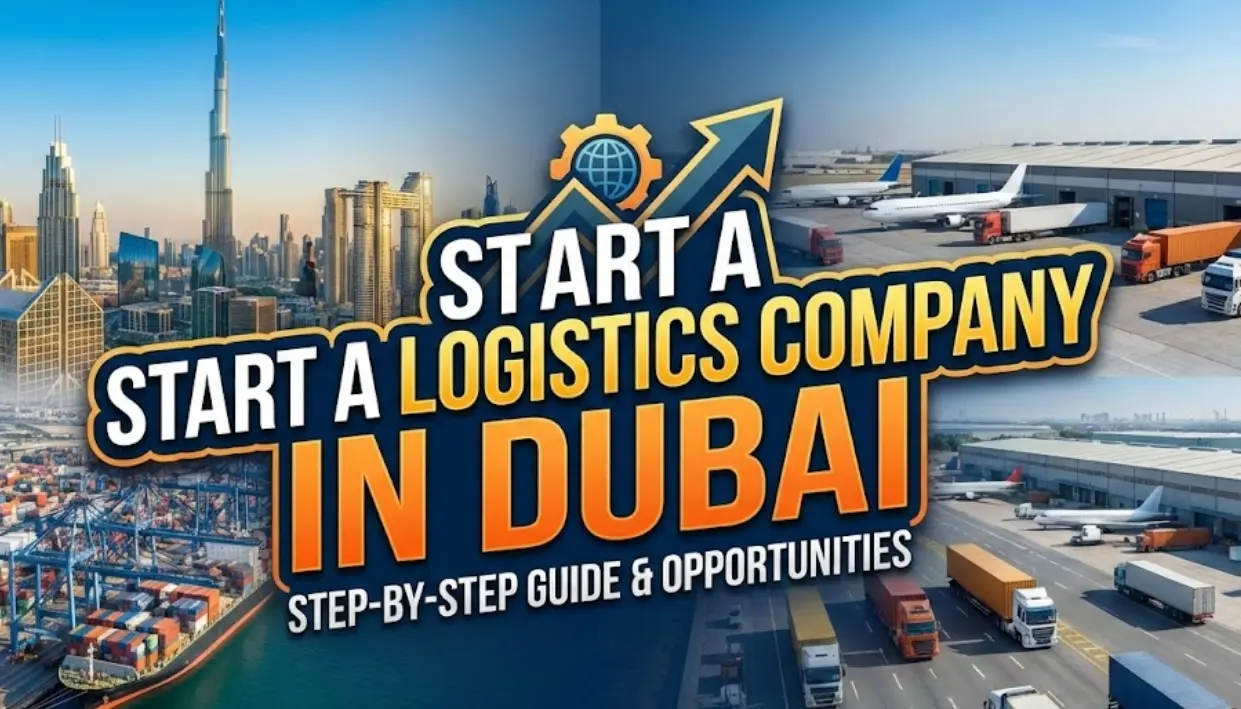
If you’ve been thinking about starting a logistics business in Dubai, you’ve picked an incredible time and place. The city’s position as a global trade hub isn’t just marketing talk—it’s backed by world-class infrastructure and a booming market that’s expected to hit USD 241.6 billion by 2030.
Let me walk you through everything you need to know to get your logistics company up and running in Dubai this year.
Dubai sits right between East and West, which means you can reach over 3 billion consumers within an 8-hour flight. That’s access to markets across Europe, Asia, Africa, and the Middle East—all from one strategic location.
The infrastructure here is honestly second to none. You’ve got Jebel Ali Port, the largest in the Middle East, handling massive cargo volumes daily. Dubai International Airport ranks among the world’s busiest cargo hubs, and Al Maktoum International is rapidly expanding its cargo capacity. The road networks and logistics facilities are equally impressive.
Here’s what really caught my attention: the UAE logistics market generated USD 169.7 billion in 2024 and is growing at 6.1% annually. That growth is being driven largely by the e-commerce boom, which has created explosive demand for last-mile delivery, warehousing, and fulfillment services.
The government is also heavily invested in making Dubai a logistics powerhouse. They’ve streamlined customs procedures, invested billions in infrastructure, and created free zones specifically designed to facilitate trade.
Before diving into the setup process, let’s talk about what services you might want to focus on.
Freight forwarding is one of the most popular options. This includes air freight, sea freight, land transportation, and customs brokerage. You handle the documentation and coordinate shipments for clients who need goods moved internationally.
Transportation and distribution involves road freight services, fleet management, cross-border transport, and express delivery. If you enjoy the operational side of moving goods, this could be your sweet spot.
Warehousing and storage is huge right now, especially with e-commerce growth. You can offer general warehousing, temperature-controlled storage for pharmaceuticals or food, or even bonded warehousing facilities.
Last-mile delivery has exploded in demand. E-commerce companies need reliable partners for same-day delivery, express courier services, and cash-on-delivery handling. The margins can be tight, but the volume opportunities are enormous.
Specialized logistics commands premium rates. Think cold chain logistics for pharmaceuticals, dangerous goods handling, heavy equipment transport, or automotive logistics. These require more expertise and certifications, but clients pay well for specialists.
You can also position yourself as a third-party logistics provider (3PL) or even fourth-party logistics coordinator (4PL), managing entire supply chains for clients who want to outsource their logistics operations completely.
This is one of the most important decisions you’ll make, and it depends entirely on your target market and business model.
Going mainland gives you complete freedom to operate anywhere in the UAE without restrictions. You can serve any customer directly, access the full local market, and even bid on government contracts.
The requirements are a bit more involved. You’ll need approval from both the Department of Economic Development (DED) and the Roads and Transport Authority (RTA). For freight activities, you’ll need a Local Service Agent—but don’t worry, this is typically a fixed annual fee, not a profit-sharing arrangement.
You must have a physical office, and costs start around AED 25,500 for the license alone. Total setup investment typically runs AED 50,000 to 200,000 depending on your scope.
Mainland is ideal if you’re targeting the UAE domestic market, focusing on last-mile delivery, or planning local distribution services.
Free zones offer 100% foreign ownership, which is a huge advantage. You get tax benefits, simplified customs procedures, and lower setup costs starting from just AED 11,900.
The popular free zones for logistics include:
Traditionally, free zone companies were restricted to trading within the free zone and internationally. However, you can now obtain a mainland trading permit for AED 5,000, which opens up local market access.
Free zones work best for international freight forwarding, import/export businesses, and e-commerce fulfillment operations.
Getting your logistics company licensed involves navigating several regulatory authorities. Let me break down what you actually need.
For mainland operations, you need a trade license from the DED. This covers your commercial activities and costs between AED 15,000 and 30,000 depending on your specific services.
The FTA oversees freight forwarding operations and transport services across the UAE. You need their approval and special activity permits for your specific logistics services.
This is critical if you’re operating vehicles. The RTA handles vehicle registration, driver approvals, and fleet authorization. You need their clearance before putting any commercial vehicles on the road.
The RTA process takes 3-6 weeks and costs vary based on your fleet size. They require vehicle details, driver information, GPS tracking systems, and insurance certificates.
If you’re handling imports and exports—and most logistics companies do—you need a customs clearance permit. This allows you to clear shipments on behalf of clients and is essential for freight forwarding operations.
Registration costs AED 5,000 to 15,000 and takes 2-4 weeks to process.
For warehousing operations, Dubai Municipality needs to approve your facility. They conduct health and safety inspections and ensure your warehouse meets all regulatory requirements.
Let me walk you through the actual process of company registration in Dubai, step by step.
Step 1: Choose Your Business Structure and Location
Decide whether mainland or free zone makes more sense for your business model. If free zone, research which specific zone aligns with your services—port proximity for sea freight, airport access for air cargo, or e-commerce focus for fulfillment services.
Step 2: Define Your Service Offerings
Be specific about what you’ll provide. Will you focus purely on freight forwarding, or include transportation? Are you offering warehousing? Do you want to be a full-service 3PL? Your license applications will need clear service descriptions.
Step 3: Register Your Trade Name
Choose a name that reflects your logistics services. Check availability with the DED or your chosen free zone authority. The name needs to comply with UAE naming regulations and get official approval.
Step 4: Apply for Your Trade License
Gather required documents including passport copies of all shareholders, a business plan outlining your operations, office lease agreement or reservation, financial projections, and detailed service descriptions.
Processing typically takes 2-4 weeks once everything is submitted.
Step 5: Obtain RTA Approval
If you’re operating vehicles, submit your RTA application with complete fleet details, driver information, vehicle specifications, proof of GPS tracking systems, and insurance certificates.
This step takes 3-6 weeks and is critical—you cannot legally operate commercial vehicles without RTA approval.
Step 6: Get Federal Transport Authority Clearance
Submit your FTA application with full business details and documentation of your service scope. They verify your compliance with federal transport regulations.
Step 7: Apply for Your Customs Permit
Register with Dubai Customs to obtain your customs broker authorization. This gives you system access to process shipments and is absolutely essential for any import/export operations.
Budget AED 5,000 to 15,000 and allow 2-4 weeks for processing.
Step 8: Secure Your Warehouse and Office Space
Your location needs depend on your services. Business centers offer office space from AED 15,000 to 40,000 annually. Free zone offices run AED 20,000 to 60,000 per year.
For warehouse space, JAFZA costs roughly AED 40-80 per square foot annually, while Dubai South runs AED 35-70 per square foot. Location matters—proximity to ports, airports, or your customer base can significantly impact operational efficiency.
Step 9: Register Your Commercial Vehicles
Once you have RTA approval, register each vehicle, install mandatory GPS tracking systems, secure commercial insurance, and obtain commercial license plates. Regular inspections are required to maintain compliance.
Step 10: Set Up Your Technology Systems
Modern logistics requires solid technology infrastructure. You need a Transportation Management System (TMS) for route planning and tracking, a Warehouse Management System (WMS) if you’re storing goods, GPS fleet tracking, a customer portal for shipment visibility, and integration with accounting systems.
Budget AED 20,000 to 80,000 for technology setup, with monthly subscription costs ranging from AED 2,500 to 11,000.
Step 11: Hire Staff and Process Employment Visas
Key roles include an operations manager, logistics coordinators, commercial drivers with proper licenses, warehouse staff if applicable, and customer service representatives.
Visa processing costs AED 3,000 to 6,000 per person and takes several weeks, so start early.
Step 12: Launch Your Operations
Develop marketing materials, establish partnerships with carriers and suppliers, implement your technology systems, create standard operating procedures, and start acquiring clients.
The entire setup timeline typically runs 8-16 weeks from initial application to operational launch.
Let’s talk real numbers. I’ve broken down both initial setup and ongoing operating costs.
For a free zone setup, expect license costs between AED 11,900 and 35,000. Mainland licenses run AED 25,500 to 45,000. Add RTA approvals at AED 5,000-15,000, FTA clearance at AED 3,000-8,000, and customs permits at AED 5,000-15,000.
You’ll need deposits for office or warehouse space, typically AED 20,000 to 100,000. Technology systems require AED 20,000 to 80,000 upfront.
Vehicles are your biggest expense. Purchasing three commercial vehicles costs AED 120,000 to 300,000, though leasing is an option at AED 4,000-9,000 monthly per vehicle.
Initial marketing should get AED 10,000 to 30,000 to build awareness.
Total initial investment typically ranges from AED 100,000 to 400,000+ depending on your scale and services.
Office or warehouse rent runs AED 5,000 to 30,000 monthly. Staff salaries total AED 15,000 to 60,000 depending on team size. Vehicle costs including fuel add AED 5,000 to 20,000. Insurance is AED 2,000-8,000. Technology subscriptions cost AED 1,500-5,000. Marketing should get AED 3,000-10,000.
Plan for monthly operating expenses between AED 31,500 and 133,000.
Your fleet is the backbone of your transportation services. Let me explain what you need to know.
Light commercial vehicles and vans work great for last-mile delivery and small shipments. Medium trucks handling 3-5 tons suit general freight. Heavy trucks of 10+ tons are necessary for large cargo. If you’re doing cold chain logistics, you need refrigerated vehicles. Specialized transport might include flatbeds or tankers depending on your niche.
Purchasing vehicles requires higher upfront capital but gives you asset ownership. Leasing means lower initial costs, greater flexibility, and typically includes maintenance.
My recommendation? Start with leasing. It preserves capital and lets you scale up or down as you understand your actual needs. Once you have steady business and proven routes, consider purchasing to reduce long-term costs.
This isn’t optional—RTA requires RTA-approved GPS tracking on all commercial vehicles. The system must provide real-time monitoring, route optimization, driver behavior tracking, and compliance reporting.
Installation costs AED 800 to 1,500 per vehicle, plus AED 50-100 monthly subscription per vehicle.
You need comprehensive insurance coverage including goods in transit insurance, third-party liability, and cargo insurance. Budget 3-5% of vehicle value annually.
Implement regular maintenance schedules to prevent breakdowns. Monitor fuel efficiency to control costs. Track driver performance for safety and efficiency. Use route optimization to reduce fuel consumption and improve delivery times. Focus on preventive maintenance rather than reactive repairs.
If you’re offering storage services, warehouse selection and management are critical.
General warehousing provides standard ambient temperature storage for multiple product types. This costs AED 30-60 per square foot annually and works for most goods.
Temperature-controlled facilities are necessary for pharmaceuticals, food and beverage, and other perishable goods. These cost significantly more at AED 60-120 per square foot annually but command premium service fees.
Bonded warehouses are customs-bonded facilities that allow duty deferment. They’re excellent for import/export operations but require additional licensing.
Proximity to ports and airports reduces transit times. Road access affects efficiency. Customer locations determine how quickly you can deliver. Free zone benefits can include simplified customs. Cost considerations vary dramatically by area.
Top warehouse locations include JAFZA for port proximity, Dubai South for airport access, Dubai CommerCity for e-commerce focus, and DAFZA for air cargo operations.
Invest in proper WMS software for inventory tracking using RFID or barcode systems, order management, space optimization, and integration with your TMS. This technology typically costs AED 1,500 to 6,000 monthly but pays for itself through improved efficiency and accuracy.
You cannot run a competitive logistics company in 2025 without solid technology. Here’s what you actually need.
A good TMS handles route planning and optimization, load planning, carrier management, freight audit and payment, real-time tracking, and analytics. This costs AED 1,000 to 5,000 monthly but dramatically improves operational efficiency.
If you’re storing goods, WMS is non-negotiable. It manages inventory, order fulfillment, receiving and putaway, picking and packing, shipping, and barcode or RFID integration. Budget AED 1,500 to 6,000 monthly.
Modern clients expect visibility. Provide shipment tracking, documentation access, booking management, invoice viewing, and communication tools through a customer-facing portal.
Your systems need to integrate with accounting software, e-commerce platforms, customs systems, client ERP systems, and carrier systems. Seamless data flow eliminates manual entry and reduces errors.
Logistics is a people business. Here are the key roles you need to fill.
Operations Manager oversees all operations, manages client relationships, and optimizes processes. Expect to pay AED 12,000 to 25,000 monthly for someone with solid experience.
Logistics Coordinators handle day-to-day shipment coordination, documentation, and customer service. Budget AED 5,000 to 10,000 monthly per coordinator.
Warehouse Staff manage receiving and dispatching, inventory management, and order fulfillment. Salaries run AED 2,500 to 5,000 monthly.
Commercial Drivers need proper commercial licenses, clean driving records, and good customer service skills since they represent your company. Pay AED 3,000 to 6,000 monthly.
Administrative Staff handle documentation, billing, and customer support at AED 3,500 to 7,000 monthly.
Invest in proper training covering safety and compliance, customer service, system operations, handling procedures, and regulatory requirements. Well-trained staff make fewer mistakes and deliver better service.
Getting clients requires strategic marketing. Here’s what works in Dubai’s logistics sector.
E-commerce companies need fulfillment services, last-mile delivery, and returns management. This is a rapidly growing segment with consistent volume.
Manufacturers and distributors require warehousing, distribution, and freight forwarding. They typically sign long-term contracts, providing stable revenue.
Retailers need inventory management, store deliveries, and supply chain solutions.
Import/export businesses are always looking for reliable customs clearance, freight forwarding, and documentation services.
Build an SEO-optimized website targeting keywords like “freight forwarding Dubai,” “logistics services UAE,” “warehouse Dubai,” and “customs clearance.” Run Google Ads focused on B2B keywords. Use LinkedIn for targeted marketing to decision-makers. List your company in industry directories.
Attend trade shows and exhibitions. Join the Chamber of Commerce and industry associations. Participate in business networking events. Build relationships—logistics is a relationship-driven industry.
Partner with e-commerce platforms, freight forwarders, shipping lines, and airlines. Strategic partnerships can quickly scale your business.
Build a B2B sales team for direct outreach. Participate in government and corporate tenders. Make cold outreach to potential clients. Deliver professional corporate presentations.
Let’s talk about what you can actually earn.
For freight forwarding, charge per-shipment fees, weight or volume-based rates, add margin on carrier rates, and charge documentation fees.
Warehousing typically uses per-pallet monthly rates, per square foot charges, handling fees, and value-added service charges.
Transportation pricing includes per-kilometer rates, per-delivery charges, fuel surcharges, and waiting time fees.
A small operation might generate AED 80,000 to 150,000 monthly revenue with 10-15% net margins, producing AED 8,000 to 22,500 monthly profit.
A medium-sized operation can achieve AED 250,000 to 500,000 monthly revenue with 12-18% margins, earning AED 30,000 to 90,000 monthly profit.
Large operations generating over AED 1,000,000 monthly can reach 15-20% margins, producing AED 150,000+ monthly profit.
Most logistics companies break even within 12-18 months if properly managed.
Compliance isn’t optional. Here’s what you must maintain.
Schedule regular vehicle inspections. Ensure all drivers maintain proper licensing. Keep GPS tracking systems operational. Renew insurance on time. Maintain safety standards across your fleet.
Submit proper documentation for all shipments. Classify goods correctly using proper tariff codes. Pay duties as required. Make accurate customs declarations. Stay audit-ready with organized records.
Maintain warehouse safety standards. Provide driver safety training. Keep equipment properly maintained. Implement incident reporting procedures. Have emergency procedures documented and practiced.
Let me share what actually works in this business.
Start with a niche specialization. It’s easier to excel and build reputation in one specific area—cold chain, e-commerce fulfillment, automotive logistics—than trying to be everything to everyone.
Invest in technology from day one. Efficiency directly impacts profitability in logistics. Good systems pay for themselves quickly through reduced errors and improved operations.
Build strong carrier relationships. Your success depends on reliable partners. Good relationships mean better rates, priority capacity, and smoother operations.
Focus intensely on customer service. Client retention drives growth. It’s far easier to grow existing accounts than constantly chase new clients.
Maintain strict compliance. Penalties and operational disruptions from non-compliance can devastate profitability. Stay on top of all regulatory requirements.
Monitor your KPIs religiously. Track on-time delivery rates, accuracy, customer satisfaction, cost per delivery, and warehouse productivity. You can’t improve what you don’t measure.
Optimize routes continuously. Route optimization reduces costs and improves efficiency. Even small improvements compound significantly over time.
Diversify your service offerings. Multiple revenue streams provide stability. A client using you for freight forwarding might also need warehousing or last-mile delivery.
Scale gradually. Prove your operations work before expanding. Rapid scaling without operational excellence leads to quality problems and client loss.
Network actively. Relationships drive business in logistics. Attend industry events, join associations, and build genuine connections.
Dubai’s logistics sector offers exceptional opportunities for entrepreneurs who approach it strategically. The market is growing rapidly, infrastructure is world-class, and government support is strong.
Success requires proper licensing, solid technology, efficient operations, and excellent customer service. The initial investment is significant, but the potential returns are substantial for well-run operations.
The setup process takes 8-16 weeks and involves navigating multiple regulatory authorities. While it might seem complex, thousands of logistics companies have successfully launched in Dubai using this same process.
Whether you’re focusing on freight forwarding, last-mile delivery, warehousing, or full 3PL services, Dubai provides the infrastructure and market access to build a thriving logistics business.
The key is starting with a clear business model, securing proper approvals, investing in the right technology, and executing with operational excellence. Do these things well, and you can build a profitable logistics company serving one of the world’s fastest-growing markets.
The question isn’t whether Dubai offers logistics opportunities—it clearly does. The question is whether you’re ready to seize them.

Get a Quote
WhatsApp Italiano
 简体中文
简体中文 Русский
 日本語
日本語 عربى
عربى